
Tags
Climate impacts in America, Displaced Americans, The Great Displacement: Climate Change and The Next American Migration by Jake Bittle (USA 2023)
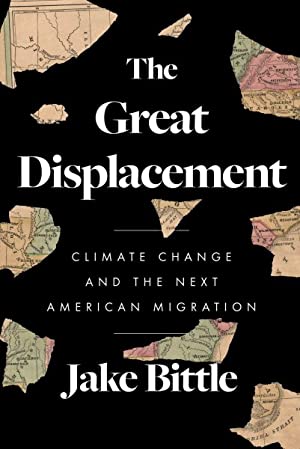
Photo Credit: Simon & Schuster (USA, 2023)
At the most fundamental level, displacement begins when climate change makes it either too risky or too expensive for people to stay somewhere. The disasters discussed in this book bear little resemblance to each other on the surface, but they all exert pressure on governments and private markets, whether through the financial costs of rebuilding or the strain of allocating scarce resources. As this pressure builds, it starts to push people around, changing where they can live or where they want to live. Sometimes this looks like the government paying residents of flood-prone areas to leave their homes; sometimes it looks like fire victims getting priced out of an unaffordable state; other times it looks like fishermen going broke as the wetlands around them erode. It may seem reductive to think about a planetary crisis in terms of financial risk rather than human lives, but that is how most people in this country will experience it—through the loss of their most valuable assets, or the elimination of their job, or a shift in where they can afford to live.
Excerpt from The Great Displacement: Climate Change and The Next American Migration by Jake Bittle, Simon & Schuster, New York, USA, 2023 (Introduction, p. xvii).
Note: The title of the book is an oblique reference to the Great Migration in American history (1920s to 1970s) when more than six million Black people left the South and moved to northern cities like New York and Chicago, fleeing an economic and humanitarian crisis.
JAKE BITTLE, a journalist based in Brooklyn, New York, is a staff writer at Grist, where he covers climate impacts and adaptation. His work has appeared in The New York Times, The Guardian, Harper’s Magazine, and a number of other publications.
 Three Worlds One Vision
In my opinion, what is added and unfortunately receives too little attention in the general discourse is the fact that fascism is also gaining strength with the migration movements. Right-wing politicians initially prepare the ground for xenophobia, which is already latent in most societies, with a “we first” attitude. When things then get tighter economically, many see the immigrants as the evil of their dwindling wealth.
LikeLiked by 6 people
Friedrich, this is also a growing concern here in the USA with the anti-everything, right-wing politicians.
LikeLiked by 4 people
This immediately put me in mind of “The Grapes of Wrath”, my review of which I know you read and commented on
LikeLiked by 3 people
Those were times of wrath, indeed, Derrick. You did well years ago when you moved to the countryside. Your area doesn’t appear to face any risks from drought, flooding, or wildfires.
LikeLiked by 3 people
Thanks a lot, Rosaliene
LikeLiked by 1 person
This has arrived and will enlarge with speed. Those with their heads in the sand will be buried there. A shame, but an opportunity to act on an international level. Fingers crossed. Thank you, Rosaliene.
LikeLiked by 3 people
Definitely a shame, Dr. Stein. With all the guns in the hands of Americans, the Wild West will return with a bang! bang!
LikeLiked by 1 person
Climate Change will get real when the rich will feel it. When more mansions will burn down because of wildfires when water will be restricted for ALL when a day on the beach will be too much to handle. Until then, there will be lots of finger-pointing and lots of denial.
We are adjusting because the change doesn’t happen rapidly enough. Just are just like the frog in the fable. “If you put a frog in a pot of boiling water it will instantly leap out. But if you put it in a pot filled with pleasantly tepid water and gradually heat it, the frog will remain in the water until it boils to death.”
Perhaps we too will cook to death and never jump?
LikeLiked by 7 people
Bridget, it does seem that, like the fabled frog, we’re slowly cooking to death 😦
LikeLiked by 3 people
I know and it’s scary.
LikeLiked by 2 people
Environmentalists have been sounding the alarms for over 40 years, and the sounds of their voices have faded into the cacophony of voices shouting at us. Those sounds, while valid, have become part of the noise pollution hurled at us with all the negative news daily seen and heard on media.
It has become all too easy to dismiss those voices, as crackpots and crazies. Only when the crisis hits people personally and financially will the majority look up from their lives.
“It may seem reductive to think about a planetary crisis in terms of financial risk rather than human lives, but that is how most people in this country will experience it—through the loss of their most valuable assets, or the elimination of their job, or a shift in where they can afford to live.”
We are approaching that point. Big corporations can do a lot to change the outcomes, but it has to be pointed out how they will benefit financially.
LikeLiked by 1 person
All that you say is sadly true, Tamara. As in many of the cases featured in Bittle’s book, those who wait too late to take action can end up losing their investment. Big corporations find ways to profit from collapse and chaos.
LikeLiked by 1 person
Only too true… :-((
LikeLiked by 1 person
Nature does not care if you believe climate change is real or if you believe it is a plot by governments or other factions. It does not care if you are rich or poor, right wing or left wing or what other label that one wishes to throw at those on opposite sides. In our area, insurers simply no longer insure and governments may fund rebuilding once but not twice. Wildfires, floods and drought are our enemy. I recall my parents telling me about living through the Dirty 30’s. History and nature have a way of repeating. It may be a cycle, but human’s help amplify that cycle. Happy Sunday Rosaliene. Allan
LikeLiked by 3 people
Allan, the insurance companies are also tightening up here in California. Last Friday, State Farm (America’s largest property and casaulty insurance provider) announced that it will stop selling new homeowners insurance policies in California because of “historic increases in construction costs outpacing inflation, rapidly growing catastrophe exposure, and a challenging reinsurance market.” There’s no money to be made in a state with an increasing number of severe wildfires.
LikeLiked by 2 people
An important post about an important book, Rosaliene. I agree with nonsmokingladybug that “climate change will get real when the rich will feel it” (more than they’re already feeling it). For the moment, most of the rich are not affected by climate change as much as the non-rich are, and we all know that the rich unfortunately have most of the power. They “buy” politicians, and get their money’s worth.
LikeLiked by 3 people
Very true, Dave, but it gets complicated. In the chapter “Bailout: Rising Seas and Falling Market” which examines a case study in Norfolk, Virginia, Bittle notes (p. 243):
“The wealthy can cut their losses and find new homes on higher ground, leaving their condos and beach houses empty while they wait for the government to sort out the mess. People who rent their apartments are also free to leave whenever their leases are up. The ones who are stuck are the middle-class homeowners, the people who emptied their savings to buy a home and can’t afford to take out a second mortgage until they off-load the first one.”
LikeLiked by 1 person
Very complicated indeed, Rosaliene. 😦
LikeLiked by 1 person
And a million other similar things are bound to happen.
In my previous school, it was all boys, with a great many of Indian or Pakistani origin. I knew that one of my pupils was going to visit Granny and Grandad in India, but his description amazed me.
The temperature averaged 42 degrees C, and most of the families in the village, which was built on sandstone, had hollowed out new houses for themselves in the rock.
So they were now all living underground! Absolutely amazing!
LikeLiked by 3 people
John, it’s definitely an amazing solution to extremely high temperatures.
LikeLiked by 2 people
Thank you for sharing!! unfortunately, the politicians are only going to cater the wishes of those that voted into power.. one does not have to wait on the politicians to do things, large and small that may and will make a difference with the future of climate, as Obama said “we are the ones we have been waiting for to make change”.. 🙂
Hope life is all that you wish for it to be and until we meet again..
May the dreams you hold dearest
Be those which come true
May the kindness you spread
Keep returning to you
(Irish Saying)
LikeLiked by 3 people
I agree, Dutch. Our future depends upon we the people. Far too many of our politicians live in a bubble coated with money from their donors.
LikeLiked by 1 person
This is such a basic conclusion, yet it avoids discussion. I haven’t read the book, but I can imagine a scenario where Canada becomes the US’s greatest asset.
LikeLiked by 2 people
You may be right, Pablo. Canada is already facing its own challenges on its northern frontier where a whole new Arctic Ocean is opening up due to the melting icecaps.
LikeLiked by 2 people
That may become a future Riviera. Or, at least Cornwall.
LikeLiked by 1 person
By 2050, we’ll be talking a lot about immigration since many places may be underwater or too hot. Wish we could act like a species with a frontal lobe and plan the changes in the way we live in order to lessen the climate impact.
LikeLiked by 3 people
Rebecca, the immigration crisis is already upon us. Have you seen the news about tens of thousands of people waiting at the US-Mexico border? As Bridget (blogging at nonsmokingladybug) mentioned in her comments, we humans are behaving just like the frog in the fable.
LikeLiked by 2 people
The border crisis is not new, although we could say it is of our own making as meddling neighbors. No, the future migration will be millions of people.
LikeLiked by 2 people
The genie is out of the bottle. The tipping points have been passed.
LikeLiked by 2 people
Neil, how foolish we were in believing that the genie would give us all that our hearts desired! Thankfully, we have not yet reached all the tipping points. Then, as Thomas mentioned in his comments, there are also undiscovered tipping points.
Readers can learn more about the “Nine tipping points that could be triggered by climate change” at Carbon Brief:
https://www.carbonbrief.org/explainer-nine-tipping-points-that-could-be-triggered-by-climate-change/
LikeLiked by 2 people
That is a great review. I bought this book and it is on my TBR list. Thank you very much for the recommendation. I am currently reading another book on the topic “The Climate Casino” by William Nordhaus. Risk, uncertainty, and Economics for a Warming World. I am almost done with the book. He won the Nobel Prize in Economics. He is trying to calculate the economic cost of climate change and find the best way to address it. He admits that you cannot put an economic price on things like species extinction and ocean acidification, or undiscovered tipping points, but the things you can put a price on can serve to illuminate.
He believes the most effective way to address climate change is if all countries enact a rising carbon price (carbon tax, cap and trade, CF&D, etc) as soon as possible. We are going to have some significant losses no matter what but it can be better or much worse depending on what we do now.
LikeLiked by 2 people
Thomas, thanks for the recommendation. I’ve added “The Climate Casino” to my To Read List. How does one price the cost of an entire species, such as the bees, or a rainforest?
LikeLiked by 2 people
A book I didn’t know about and it looks like one everyone should read…Thanks
LikeLiked by 2 people
You’re welcome, Kim. It’s well researched. His case studies are an eye-opener for me.
LikeLiked by 1 person
This is the scariest part of climate change for me. That about 2 BILLION people could be on the move because their home is no longer habitable, Rose.
LikeLiked by 2 people
Pam, according to Bittle, “More than six million Americans have experienced internal displacement in the past decade alone, and in the summer of 2021 around one in three Americans experienced a weather disaster” (p. 256).
I’ve been wondering lately how many of the homeless living on the streets in Los Angeles are climate displaced. How many of them are from other states?
LikeLiked by 2 people
Wow, I never thought of that, Rose. I thought it was economics that drove people out of their homes and into the street but the drought in CA has been going on a long time so maybe that’s a hidden cost of climate change.
LikeLiked by 2 people
Pam, I don’t think that economics is the entire story.
LikeLiked by 2 people
😞
LikeLiked by 1 person
I had a professor for econometrics who was studying the effects of wildfire on home prices in California. He actually shared things he did in his work, and some insights he got from it. Let’s just say numbers don’t lie and it was depressing
LikeLiked by 1 person
Claire, it is, indeed, a depressing situation, especially for those who have already lost their homes to wildfires here in California. Brittle dedicated a chapter to “Wildfires, Insurance, and the Housing Crisis in Santa Rosa, California.”
LikeLiked by 1 person
Oh wow Rosaliene, this sounds like a very interesting read. Climate change is something all of us need to be concerned about because where will we run to when there is no escaping this? Our weather patterns are already in crisis mode. Thanks so much for sharing your review. 😊💖🤗
LikeLiked by 2 people
It is an interesting read, Kym. Brittle puts a face on Americans already impacted by our global climate crisis and the challenges they face. He takes readers to Kinston/North Carolina (flooding), Santa Rosa/California (wildfires), Pointe-au-Chien/Louisiana (coastal erosion), Houston/Texas (flooding), Pinal County/Arizona (drought), and Norfolk/Virgina (rising seas).
LikeLiked by 2 people
Scary isn’t it Rosaliene? It’s amazing how some people still don’t take such climate crises seriously. Thanks for sharing. 🤗💖😊🙏🏼🥰
LikeLiked by 2 people
My pleasure, Kym 🙂
LikeLiked by 1 person
🥰💖🤗
LikeLiked by 1 person
Rosaliene there is Climate Change in our area..Last week so many fires in these forests and hundreds of houses were burned. Anita
LikeLiked by 1 person
Where is your area located, Anita? Stay safe.
LikeLiked by 1 person
Rosaliene we are located here in Halifax. But so much smoke here . But no fire on our street . Anita
LikeLiked by 1 person
Thanks for the info, Anita. The smoke is bad for our health, so, if possible, stay indoors.
LikeLiked by 1 person
We stay indoors too. We shut our windows down. Anita
LikeLiked by 1 person
I’m going to buy this book. My daughter is working with NASA again this summer and I’m so drawn to learn more about climate change. Thank you for sharing.
LikeLiked by 1 person
You’re welcome, Belladonna 🙂 Bittle’s book offers excellent insight into the ways in which the climate crisis is already upending the lives of those impacted.
LikeLiked by 1 person